Conjunction (Basic ㊦ 328)
A subordinate conjunction which expresses a reason or a cause.
Equivalent: So; since; because
| (i) {V/Adjective い} informal | ので | |
| {話す /話した} ので | Because someone (will) talk/talked | |
| {高い /高かった} ので | Because something is/was expensive | |
| (ii) {Adjective な stem/ Noun} | {な/だった} ので | |
| {静かな/静かだった} ので | Because something is/was quiet | |
| {先生な/先生だった} ので | Because someone is/was a teacher |
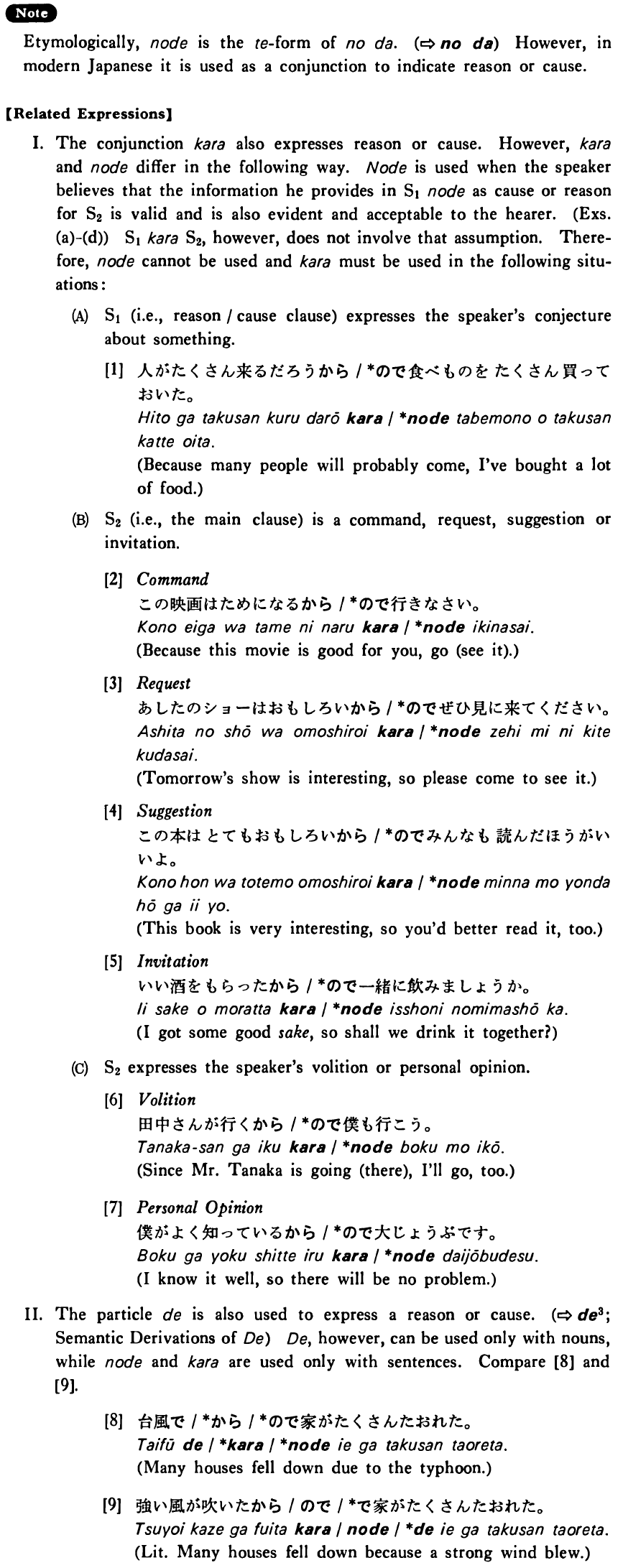
Etymologically, ので is the て form of のだ. (⇨ のだ) However, in modern Japanese it is used as a conjunction to indicate reason or cause.
【Related Expressions】
I. The conjunction から also expresses reason or cause. However, から and ので differ in the following way. ので is used when the speaker believes that the information he provides in Sentence1ので as cause or reason for Sentence2 is valid and is also evident and acceptable to the hearer. (Examples (a) - (d)) Sentence1からSentence2, however, does not involve that assumption. Therefore, ので cannot be used and から must be used in the following situations :
(A) Sentence1 (i.e., reason/cause clause) expresses the speaker's conjecture about something.
[1](B) Sentence2 (i.e., the main clause) is a command, request, suggestion or invitation.
[2] Command
[3] Request
[4] Suggestion
[5] Invitation
Sentence2 expresses the speaker's volition or personal opinion.
[6] Volition
[7] Personal Opinion
II. The particle で is also used to express a reason or cause. (⇨ で3; Semantic Derivations of で) で, however, can be used only with nouns, while ので and から are used only with sentences. Compare [8] and [9].
[8]
[9]